| Tweet |
|
Don't Lose Your Head in the Heat
It may seem needless to say, but I will do it anyway: Don't assume that people are friendly just because they appear friendly. It's tempting to arrive in the beautiful nature and the warm climate of the south and take a word for a word. Despite the reputation of the French, there are genuinely friendly Frenchmen, and there are Frenchmen who appear friendly so long as everything goes to plan. In the vast majority of cases, you will not encounter any problems in France, but don't be naive. Use your common sense. There are criminals and conmen around who prey on tourists.
French Tourist OfficesWhen you use any sort of book or commercial source for finding service providers in France, you are probably aware that the providers listed are not necessarily those who are the best matches for your needs but those who have paid for being listed. Thus, you would not expect an objective selection, and you might supplement that selection with other sources. You are probably not surprised if I tell you that French tourist offices require a small contribution for listing providers. The amount can be quite modest. As the offices de tourisme appear as official sources of information, you may tend to give more weight to their selections and advice than what you find in commercial sources. |
However, you need to be aware that the purpose of the tourist offices is to serve the very strictly local interests of their town or village and its very strictly local providers with an address in their town. You are mistaken if you think the purpose is to help you, the tourist, find the most suitable offer. If a provider that is available for tourists in a major town but is domiciled just 10 km (6 miles) from the town limit asks to be included in the tourist office listings and pay for it, the request will be turned down, so as to prevent competition with the very local providers domiciled in the town concerned. These local providers can then maintain a higher price level, and guess who pays for that. The town limit is obviously justified for companies with a fixed place of business, but in case of transport and excursion services, you don't really care where the provider is domiciled, as they will be coming to you, and it is not a problem if they have to drive a short distance to get to you.
My very simple advice is to consider the tourist office information about providers as no more than commercial information with all the bias and selection that you would expect from a purely commercial source. In most cases, you will get a more neutral result through Google, and you may obtain considerable savings by not only listening to the tourist offices. Just beware that they use their "official" image to further limited commercial interests, and remember that they are not there for you but for themselves.
Tipping and Service
Some tourist guides try to make you believe that you have to tip all the time. All tipping is voluntary, and the French themselves mostly don't tip at all, whether it's at a restaurant, hotel or taxi. If you feel well treated and you had a nice experience, then by all means you can leave a reasonable tip, but there is no need to start calculating percentages of the bill. That is not to say that tips are not appreciated. Of course they are. Staff in the tourist sector often work inconvenient hours, evenings, nights, weekends, holidays and they are mostly not very well paid. They may well work throughout the summer without vacation and only have time off during the winter season - when many of them would be unemployed, as they would be seasonal workers. Americans travelling in Europe often tip as if they were in the United States, and it is a fact well known amongst tourist personnel that the chance of getting a good tip from an American is many times higher than getting even a small tip from a Dutchman or a Scandinavian, for example. It means that some staff might be a bit more tolerant or willing to provide a little extra if they know you are American, but it is absolutely no guarantee.
If you do tip, do it in euros, which is the only accepted currency in France. Polite staff won't say anything if you tip in dollars, since it's voluntary, but a small amount in dollars isn't worth anything for the employee, as there won't be much left after exchange rate commission - which can be up to 12% - and other fees, and it is impossible to buy anything with dollars. The employee would have to collect such dollar bills over several years and hope the dollar rate isn't falling any further in the meantime, until there are enough to justify the hassle of changing them to euros. Contrary to some Latin American countries, dollars are not commonly accepted as payment in Europe. Just imagine the reaction of a waiter in the US if you handed him or her a euro bill as a tip.
If you want good service, try to be aware of the French sensibility to being faced with direct requirements as if you had the 'right' to this or that. That doesn't work in France, it can be seen as downright rude, and it is only likely to produce the opposite result when the French waiter demonstrates that he doesn't take orders. Be more subtle and indirect and if you know enough French ask "would it be possible to ...", "can I ask you to help with ..." etc.
If you tip, think about who you want to tip. In a taxi, it's obvious, but in restaurants, some owners try to confiscate tips from the waiters. If you add the tip to the credit card bill under "extras", you can be sure that only the owner will profit. If you leave the tip on the table when you leave, some owners would confiscate it. If you want to tip the waiter, try to give it to him directly.
Weather
Weather France
Meteo.fr.
Meteoconsult.
Lycos.
Pages
Jaunes. Weather by city.
La Poste.
Yahoo.
International weather
BBC.
Danmarks Meteorologiske Institut.
In Danish and partially English.
Meteocity.
TV5.
August
August is the French holiday month. All the most important people go on holiday during this month, and only the least qualified personnel would remain working. Try not to get sick in France in August. You may find it difficult to find a qualified doctor. In case of serious illness, consider urgent repatriation very seriously, as even hospitals will not be working well, and all the experienced doctors will be on holiday.
All the French Holidays - School holidays
| New Year's Day | 1 January | |
| Easter (pâques)Monday | Floating | |
| Labour Day | 1 May | |
| End of World War 2 | 8 May | |
| Ascension | Floating | |
| Whit Monday (pentecôte) | Floating | |
| National (Bastille) Day | 14 Juillet | |
| Assomption | 15 August | |
| All Saints Day | 1 November | |
| End of World War 1 | 11 November | |
| Christmas Day | 25 December |
French Ministry of Education: School holidays (vacation).
Even if you don't live in France, you may want to plan holidays and breaks outside French school holidays, so as to avoid heavy traffic and higher prices. Most Frenchmen take their summer holidays between mid-July and the end of August. This is the most expensive period, and it culminates in the last week of July / first week of August, where accommodation in the south is hideously expensive.
Administrative regions of France
Many websites will require that you fill in a field with the départements or région, for example to search for a hotel. This may be quite confusing if you only know the name of a city. My page "Living & Working in France" has a complete list and maps where you can find the information you need.
Health Care in France
Residents of the EU/EEA and Switzerland can - with very few exceptions - obtain a European Health Insurance Card from their local public health insurance administration. This card provides the same cover as the former E111 form. It confirms the right to the holder to obtain health care at the same cost as the country's own residents pay in their country. In France, this means that you will get a refund of typically 70% of emergency medical expenses, 80% of hospital expenses. The remaining part is at your charge. Note, the refund percentage is based on the rate that the public has agreed with medical professionals working with set fees (conventionné secteur 1). If you visit hospitals or medical professionals that decide their own fees (conventionné secteur 2), then you pay the excess yourself.
A few countries like Denmark may provide their own travel insurance for all citizens, and in case of the Danish cover, it is better than the EU cover. Other citizens are strongly advised to take out additional travel insurance to avoid unpleasant surprises in the form of medical expenses. If you advance funds to medical professionals, including pharmacies, be sure to ask for receipts for later refunds.
Dangerous sights
Certain sights, typically ruins and nature, have insufficient protection compared with what you may be used to in your part of the world. If there are any railings at all, they may only protect adults, while a child can easily walk underneath upright and fall off a cliff. That is the case for example at the Baux de Provence and the ruin in Hyères. Don't expect to find any warning signs. If you have children, it's your entire responsibility if they walk out from an unprotected cliff somewhere. Certain ruins may be unsafe both for adults and children but without any barrier or warning to prevent you from going in there. Safety is occasionally upgraded here and there, but it often takes a deadly accident first. Caveat emptor.
French Hygiene
Evil tongues will say that French hygiene is an oxymoron. The Belgians have a joke about the French that goes: "How do you get a Frenchman out of a bathtub?" Answer: "Just put water in it". That is of course not true, but the French being a Latin people, they have a more laisser-faire style attitude to certain things, hygiene included.
What you see to the right is a classic feature of French cities and towns, although they do try to keep tourist areas clean - the French, not the dogs, of course. But should you stray away from the well-trodden paths of other tourists, you may just as well beware of certain 'features' that you are likely to find on the ground.
Hygiene in restaurants can be a problem, as it can in many other countries. There is no easy way to know how clean a restaurant's kitchen is. Some travellers recommend checking the toilets to get an idea of the establishment's idea of hygiene. Food poisoning does rarely occur because of bad restaurant hygiene, but I have no statistics to compare with other countries. Even fast food can be concerned. In 2011, a young man died because of food poisoning after having eaten in the Quick fast-food restaurant in Avignon. Laboratory tests confirmed the presence of staphylococcus bacteria in the kitchen, in the deceased's stomach, and on a number of kitchen staff. Hygiene standards were not applied in the kitchen. There was no sink for kitchen staff to wash their hands, for example. I'm not aware of such incidents with international fast food chains. A type of restaurant where hygiene problems are often revealed is kebab restaurants, because the rotating meat spike is not treated correctly. I would generally recommend avoiding dodgy-looking places.
Tap water is generally drinkable if provided by a public network. There is no need to avoid it anywhere in France. The water quality is surveyed and will generally conform to the strictest regulations. However, if you get out in the countryside where no water network is available, tap water would usually be provided from a drilling in the ground. It may or may not be clean. Public supervision with this type of water is in many cases insufficient. In many old farm houses, the water drilling would be placed right next to the septic tank, which is today illegal, as there must be a minimum distance of 35 metres between them.
Hence, you cannot know how clean tap water is at the countryside, neither in a rented house, a restaurant nor in a hotel. Too many Frenchmen simply don't care about such things, authorities included. The way such Frenchmen think is that tourists are unlikely to return anyway, so it doesn't matter if things or food are really totally clean or fresh. In general, you can presume that the further south you get, the more dirty it is.
Public toilets is something you would rather avoid, TGV trains included. A Belgian once told me the following joke about France, based on the linguistic fact that "toilets" can only be plural in France ("the toilets"), whereas you can say "one toilet" in Belgium. So, asks the joke, what is the reason for this linguistic difference? Simple: in France, you need several toilets to have a chance to find one that's clean.
Emergencies, insects, snakes, wild animals
| In case of an emergency on land or sea, call the common EU emergency number 112, common for police, medical emergencies, fire, and coast guard. |
- In theory, the emergency centres must be able to handle calls in several languages, but don't expect linguistic miracles in France.
- On mobile (cell) phones, an emergency call to 112 will remain connected even if the signal is so poor that the call would normally be disconnected.
- 112 calls are free and will be connected even if there is no credit on your SIM card or account.
- Even if you don't know the PIN code of a SIM card, it may be possible to call 112 by typing 112 instead of the PIN code, then the CALL button.
- It may also be possible to call 112 without unblocking the keypad first (in cases where the phone is already turned on).
- It is possible to call 112 using any operator even without a subscription; the call will usually be routed using the first operator found.
- 112 calls have high priority and will usually succeed even if the network is saturated.
- Contrary to most other EU member states, there must be a SIM card in the mobile phone in France; this is to assure the call can be traced and located to help the emergencies finding you.
Mortal incidents because of insects, snakes or animals are rare in France but do occur. France has vipers, scorpions, centipedes, wasps, hornets, wild boars, wolves, and bears. Some spiders can bite, but the symptoms are mostly insignificant.
|
The vipers, scorpions and centipedes are rarely mortal but can cause inflammations and other unpleasant symptoms. A viper bite should always be taken seriously, though. Scorpions in north Africa can be highly toxic and deadly, but while the species found in France do contain a nerve toxin, it is not mortal for a healthy person. In general, the further south, and the further into the garrigue (scrubland), the higher the possibility of finding scorpions. For example, in the Luberon in Provence, I regularly have to get rid of scorpions in my bedroom because we have the garrigue right outside, whereas in a farmhouse in Saint Andiol near Avignon, I never saw any during six years because the land around us was more cultivated. The largest scorpions I've seen were around 5 cm (2") long. |
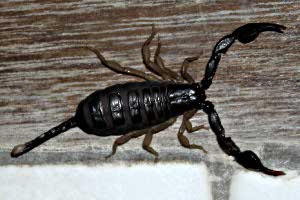
Scorpion photographed just after sneaking into my bathroom through an open window in the Luberon, Provence. This one was about 35 mm / 1.5" long. Adult scorpions are typically 5 cm (2") long in France. Nasty to watch but not dangerous for a healthy person. This one is now an ex-scorpion. |

Scorpion found in my house in the Luberon, Provence, photographed just after it had a 'traffic accident'. |
We're not talking about the monsters from hotter climates that can get up to 25 cm (10") long. Scorpions prefer darkness and avoid the light. If you intend to go hiking in scrublands or woodlands in the south, it is advisable to use footwear that covers the ankles and tight-fitting trousers and to carry a small pump available in pharmacies that can suck any poison out of the skin after a bite. Also be aware if camping in the south. Check footwear and clothes before dressing, as scorpions appreciate protected and dark places after a night's hunt. If bitten or stung, try to stay calm, as getting hysterical will make the blood circulate faster and thereby distribute the poison faster around the body. If necessary, find a doctor or hospital. |

This guy here is a couleuvre. It roughly translates into grass snake, but neither term is precise. They are harmless, nonvenomous snakes, or if venomous not known to be harmful to humans. The chap you see on the photo was roughly 1 metre/1 yard long. As it can be seen, it had a tragic traffic accident just before this photo was taken, as a car driving in the opposite direction ran over it just after I had spotted it. It died shortly after. There is no need to panic if you see one of those. The best is to leave them alone.

European hornet found in Provence. This guy was about 2 cm long in curled-up position so would be about 3 cm long if straight (1" = 2.54 cm). They look frightening because of their size but are neither dangerous nor aggressive. This one had an 'accident' and is therefore slightly less presentable than an active one. |
Wasps are wasps, no more dangerous than in northern Europe, and just as annoying. What hornets are concerned, one should separate myths from
facts. It is claimed that a hornet's sting is much more powerful than a wasp's
sting. This is exaggerated, but it is much more painful because of the different
composition of the venom and the thicker stinger. It is estimated that 150
simultaneous hornet stings are necessary to kill a healthy person. Hornets are
considered peaceful in the sense that they only attack if they feel threatened.
Contrary to wasps, they are attracted by light and may therefore enter houses in
the evening if the windows are open. By turning on and off the lights, one can
direct them elsewhere. The Asian predatory wasp, in French known as the Asian hornet (frélon
asiatique), is dangerous. One
sting may kill a healthy person even if that person is not allergic, and death
can happen very fast. It should not be confused with the
much larger Asian giant hornet which is not found in Europe. The Asian predatory
wasp was introduced to France around 2004 by accident via a shipment from China.
It has invaded south west France and parts of Spain. Sightings have been
reported as far east as Avignon in 2011. Not only are they dangerous to humans, they can
destroy an entire beehive, since European bees have not learnt through the
centuries to defend themselves, contrary to Asian bees. Wikipedia: Asian giant hornet (not present in Europe) |
People with allergies are advised to take suitable precautions after medical advice before travelling, and to be equipped with any necessary medication in advance.
One place wild boars are found is in the Luberon in Provence. They annoy farmers by eating their melons on the fields, but they can also attack. I've seen hunters bring in a dog injured by an attacking wild boar to a vet, for example. One night at the outskirt of the town, a wild boar crossed the road ahead of my car. Even if one is safe within the car, a collision could cause damage.
Bears have been released in the wild in the Pyrenees but I have not yet heard of any attacks on humans.
Wolves are found not only in French banks but also in the nature, for example the southern Alps. It was reported in 2011 that 400 sheep had been killed by wolves in the first six months of the year and that wolves get closer and closer to houses, attacking in plain daylight. I have not heard of attacks on humans, though.
If you stay in touristy places, the risk is almost negligible. It is if you venture out in the nature on your own that you need to take precautions and inform yourself of the local risks. If you are worried, it would be a good idea to read about each risk in advance, for example on Wikipedia, so as to better understand each risk. Knowledge can often help avoiding panic and hysteric reactions that will only make things worse.
Mobile Telephones (Cell phones) & other mobile devices
France has four independent mobile networks: SFR, Orange, Bouygues, and Free. France has a good cover, but if you should find yourself at a spot without cover, then try to roam in on another operator. Cell phones and other mobile devices from other countries may or may not work, depending on the frequencies they support, or they may not work on the fastest networks but only on a lower-speed network. Some of Apple's latest mobile devices, even if sold in Europe, only support the fastest 4G networks on the frequencies used in the US but not European frequencies. This subject is hugely complicated. If you need to be sure whether a certain device will work or not, it would be a good idea to study the question before travelling.
Electric Plugs and Voltage
Electric plugs are not harmonised in the EU. Plug adapters for the most commonly occurring foreign plugs (typically the UK and the USA) are available in DIY stores. Travellers would be best advised to buy an adapter in their own country to avoid the trouble of searching once in France, unless local plugs are compatible with French plugs.
230 volts AC 50 Hz (cycles) is the standard in the EU. Electric equipment should normally have a safety margin of +/- 10% to allow for variations in the power supply, so equipment rated between approximately 210 volts and 250 volts should work. Check not only the voltage rating for your equipment before using it, but also the cycles supported (typically 50 Hz or 60 Hz or both). Some equipment may work with either; other may not. Check the rating for your equipment before plugging it in.
Converters and Adapters
MCC Cables.
Worldwide plug guide.
Multitel.
International Telephone adapters.
Teleadapt. Adapters for foreign telephone plugs.
220giftcenter.com.
Mains converters/transformers.
Digitalwirelessgroup.
Mains adapters and converters/transformers. US based.
Voltageconverters.
Mains adapters and converters/transformers. US based.
Familyonboard.
Mains adapters and converters/transformers. US based.
Voltage-converter-transformers.
Mains adapters and converters/transformers. US based.
Goyona France. Transcoders for TV and video.
Vortex. Transcoders for TV and
video
comments powered by Disqus
© Copyright Streetwise-France.com 2001, 2011. All rights reserved. Background photo credits.